


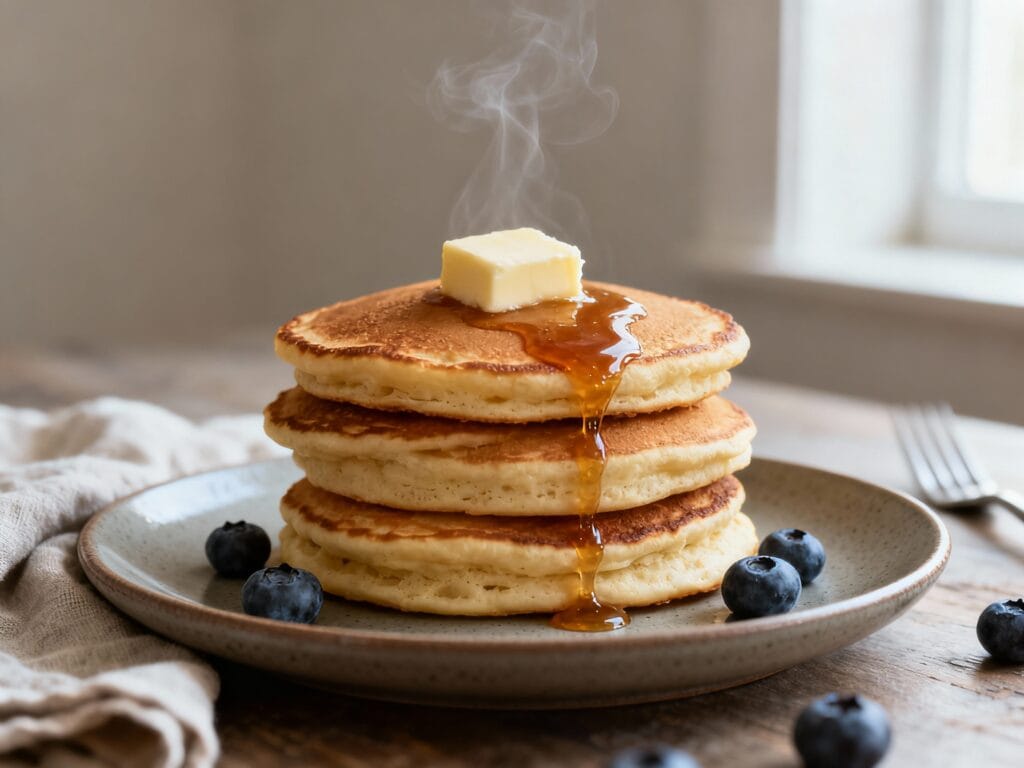
If your weekday mornings are chaos but you still want pancakes that taste like a weekend, this homemade pancake mix is the move. It’s the exact dry mix I keep on standby so all I have to do is add a few wet ingredients and cook.
Below you’ll get the precise ratios, plus an easy way to scale for 1, 5, or 10 batches so you can make a cute jar for yourself or a big container for the whole house.
Why You’ll Love This
It’s budget-friendly, tastes better than boxed, and scales perfectly without guesswork—so you can make just enough for tonight’s “breakfast for dinner” or prep a giant batch for the month.
Ingredients
- All-purpose flour (or white whole wheat flour for a heartier vibe)
- Granulated sugar
- Baking powder
- Baking soda
- Fine salt
Exact dry mix ratio (by weight): 500g flour : 50g sugar : 24g baking powder : 6g baking soda : 10g salt (this is 1 batch).
Exact dry mix ratio (by volume): 4 cups flour : 1/4 cup sugar : 2 tablespoons baking powder : 1 1/2 teaspoons baking soda : 2 teaspoons salt (this is 1 batch).
To make pancakes (per 1 batch of dry mix): You’ll also need 4 large eggs, 4 cups milk (dairy or unsweetened non-dairy), 1/2 cup melted butter or neutral oil, and 2 teaspoons vanilla (optional but highly recommended). This yields about 18–24 medium pancakes, depending on your scoop size.
Scaling guide:
- 1 batch: 500g flour, 50g sugar, 24g baking powder, 6g baking soda, 10g salt (or the volume amounts listed above)
- 5 batches: 2500g flour, 250g sugar, 120g baking powder, 30g baking soda, 50g salt (or 20 cups flour, 1 1/4 cups sugar, 10 tbsp baking powder, 2 1/2 tbsp baking soda, 3 tbsp + 1 tsp salt)
- 10 batches: 5000g flour, 500g sugar, 240g baking powder, 60g baking soda, 100g salt (or 40 cups flour, 2 1/2 cups sugar, 20 tbsp baking powder, 5 tbsp baking soda, 6 tbsp + 2 tsp salt)
How to Make It
- Choose your container. For 1 batch, a large jar works. For 5 or 10, use a big airtight canister or food-safe bucket with a lid.
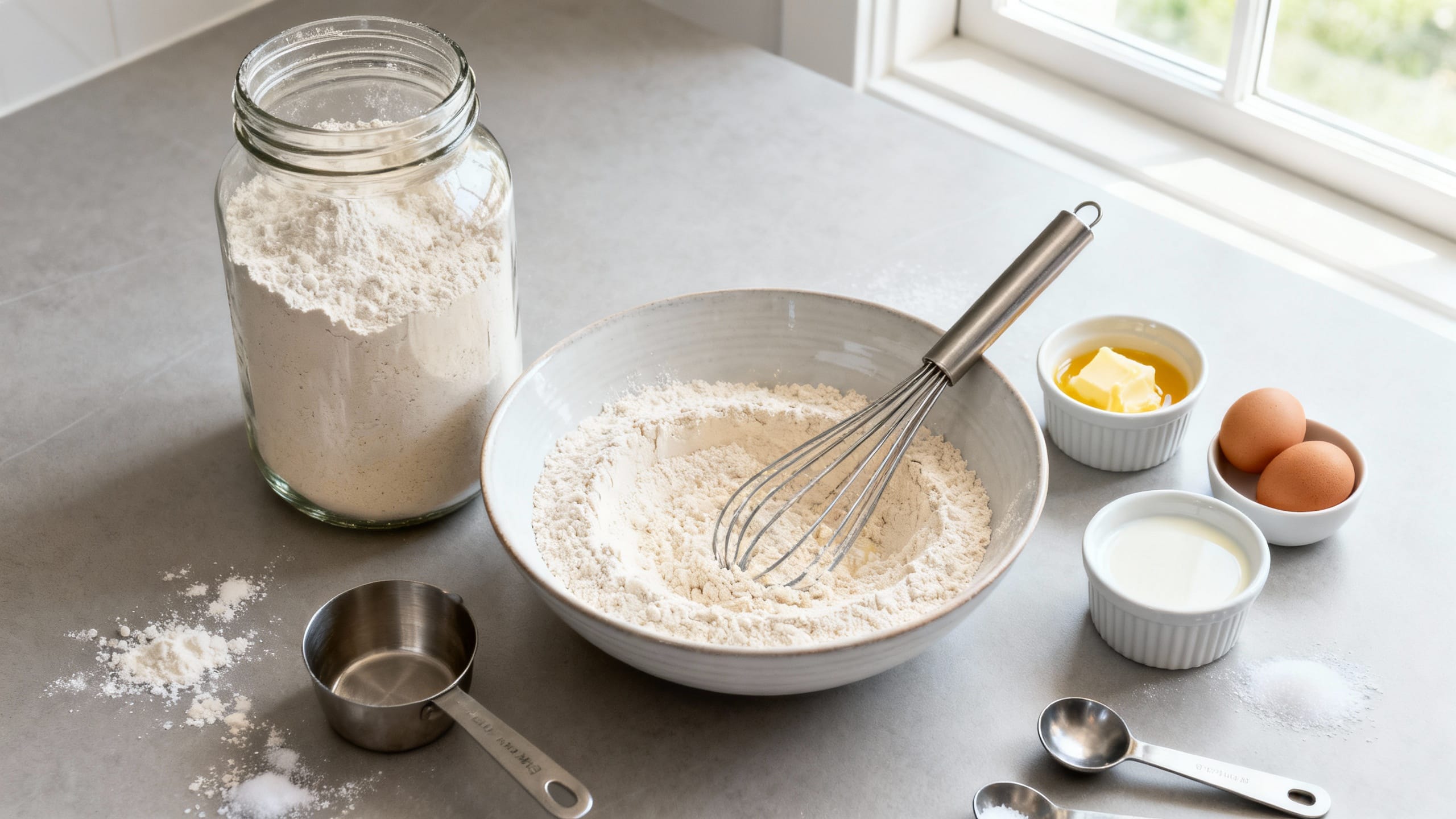
- Measure the dry ingredients. For best accuracy (especially when scaling), weigh them. If using cups/spoons, fluff flour, spoon into the cup, and level.
- Whisk everything thoroughly. In a huge bowl, whisk flour, sugar, baking powder, baking soda, and salt until totally uniform. This is the key to consistent pancakes.
- Sift if you want extra insurance. Not required, but if your baking powder is clumpy or you’re making 10 batches, sifting helps distribute leaveners evenly.
- Store and label. Transfer to your container and label it with the date plus the “to-make” instructions: for each 1 batch dry mix add 4 eggs, 4 cups milk, 1/2 cup melted butter/oil, and vanilla.
- Make pancake batter. In a bowl, whisk eggs, milk, melted butter/oil, and vanilla. Add the dry mix and stir gently just until combined (a few lumps are good).
- Rest the batter. Let it sit 5–10 minutes so the flour hydrates and the pancakes cook up fluffier.
- Cook. Heat a lightly buttered skillet or griddle over medium heat. Scoop batter (about 1/4 cup per pancake). Flip when bubbles set on top and edges look a little dry, then cook 1–2 minutes more.
- Serve or keep warm. Hold finished pancakes in a 200°F oven on a sheet pan while you finish the batch.
Tips for the Best Results
- Use a scale for scaling. When you’re multiplying batches, weight measurements keep the leaveners from drifting off-ratio.
- Don’t overmix. Stir until you don’t see dry flour; lumps = tender pancakes.
- Medium heat wins. Too hot and you’ll get burnt outsides and gummy centers.
- Resting is not optional (okay, it is, but don’t skip it). 5–10 minutes makes a noticeable difference.
- Refresh older leaveners. If your baking powder or soda is older than 6–12 months, replace it for maximum lift.
- Make a test pancake. The first one tells you if your pan is too hot or if you want a splash more milk.
Variations
- Buttermilk-style: Replace 2 cups of the milk with 2 cups buttermilk or plain kefir for tang and extra tenderness.
- Whole grain: Swap up to 50% of the flour for white whole wheat. Add a splash more milk if batter thickens.
- Chocolate chip: Fold 1 to 1 1/2 cups chips into the finished batter (not the dry mix, unless you’re storing short-term).
- Blueberry: Sprinkle berries onto pancakes right after pouring batter on the griddle so they don’t bleed everywhere.
- Warm spice: Add 1–2 teaspoons cinnamon to the dry mix per batch for cozy pancakes on demand.
Storage & Reheating
Store the dry pancake mix airtight in a cool, dry pantry for up to 6 months (longer if your ingredients are super fresh, but 6 months keeps the rise reliable). Cooked pancakes keep 3–4 days in the fridge or up to 2 months frozen; reheat in the toaster, a skillet over low heat, or a 350°F oven until warmed through.
FAQ
How much pancake mix do I use for one breakfast (like 2–3 people)?
As a rough guide, 1 batch makes about 18–24 medium pancakes. For 2–3 people, you’ll usually want about 1/2 batch of dry mix and then halve the wet ingredients too (2 eggs, 2 cups milk, 1/4 cup melted butter/oil). If your crew is hungry-hungry, go full batch.
Can I scale this by volume instead of grams?
Yes, and the post includes 1, 5, and 10 batch volume amounts. Just know that flour packs differently from kitchen to kitchen, so if you want truly “exact ratios,” a scale is your best friend—especially once you hit 5 or 10 batches.
Why does this mix include both baking powder and baking soda?
Baking powder gives reliable lift, while baking soda helps with browning and a lighter texture, especially when your batter includes acidic ingredients (like buttermilk). Using both makes the pancakes fluffy and nicely golden without tasting overly “leavened.”
My pancakes are too thick or too thin—how do I fix it?
After resting, batter naturally thickens. If it’s too thick, whisk in milk 1 tablespoon at a time until it ribbons off the whisk. If it’s too thin, sprinkle in a spoonful or two of dry mix and gently stir (then rest 2 minutes).
Can I add powdered milk or powdered eggs to make it a just-add-water mix?
You can. For a true pantry “add water” version, whisk in powdered milk to the dry mix and keep the eggs separate (or use an egg replacer powder). Results can be slightly less rich than using fresh milk and