


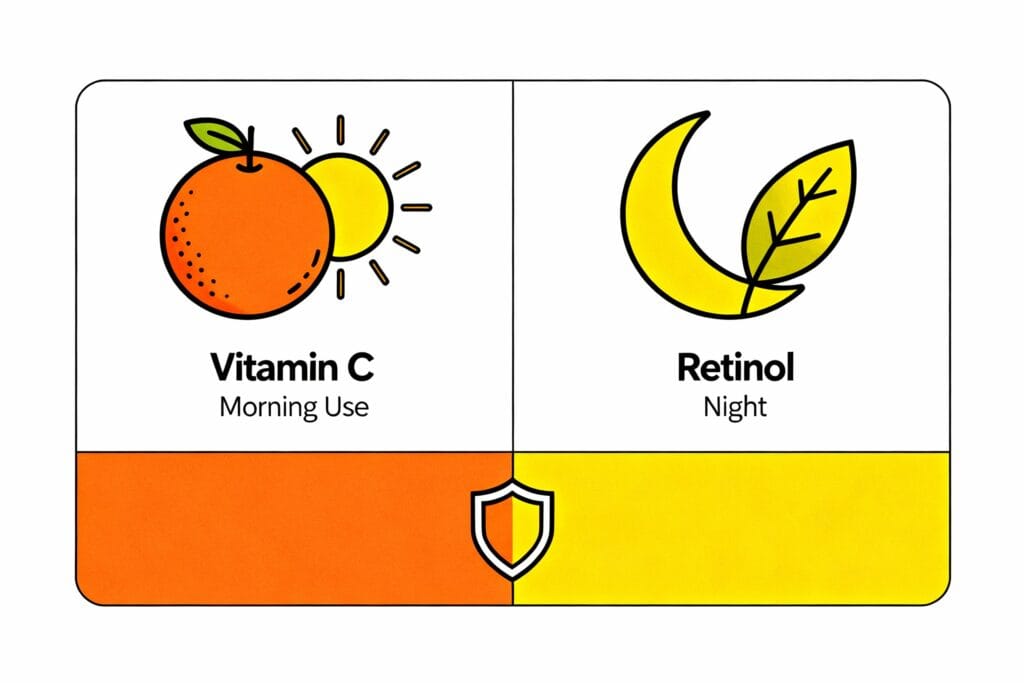
Vitamin C and retinol are like the lead singers of your skincare lineup—both stars, totally different genres. One brightens and shields; the other renews and smooths. Use them right, and you’ll get glow and bounce.
Use them wrong, and you’ll get redness, flakes, and regret. Let’s make them play nice.
Vitamin C vs. Retinol: What They Actually Do
Vitamin C (ascorbic acid) acts like a daily bodyguard.
It fights free radicals, boosts collagen, and brightens dark spots. Think: prevention + glow.
Retinol (a vitamin A derivative) speeds up cell turnover, softens fine lines, tackles acne, and refines texture. Think: correction + renewal.
Easy way to remember? Vitamin C = daytime defense. Retinol = nighttime repair.
They’re not enemies—just wildly different personalities.
When To Use Vitamin C
Reach for vitamin C in the morning. It amplifies your sunscreen, fights pollution, and makes skin look awake even when you don’t feel it. It also helps fade post-acne marks faster.
Best for these goals
- Brightening: Dullness, uneven tone, dark spots
- Protection: Antioxidant shield against UV and pollution
- Firmness: Collagen support over time
What to look for on the label
- Pure L-ascorbic acid at 10–20% for fast results (can be more irritating)
- Gentler derivatives (SAP, MAP, 3-O-ethyl, ascorbyl glucoside) if you’re sensitive
- Stable formulas: Airless pumps, opaque bottles, pH 3–3.5 for LAA
When To Use Retinol
Use retinol at night.
Sunlight can degrade retinoids, and your skin does most of its repair work while you sleep anyway. Start low and slow unless you enjoy flaking (you won’t).
Best for these goals
- Fine lines and wrinkles
- Acne and clogged pores
- Rough texture and enlarged-looking pores
Choose your strength
- Beginner: 0.1–0.3% retinol or retinaldehyde 0.05%
- Intermediate: 0.3–0.5% retinol or retinaldehyde 0.1%
- Advanced: 0.5–1% retinol (or prescription tretinoin per your derm)
Can You Use Vitamin C and Retinol Together?
Short answer: Yes, but separate them. Vitamin C in the morning, retinol at night.
That’s the simplest, safest, most effective combo. IMO, that’s the gold standard for most skin types.
Why separate? They work best at different times and pH levels, and using both at once can increase irritation.
You also want vitamin C’s protection during the day and retinol’s repair at night. Easy.
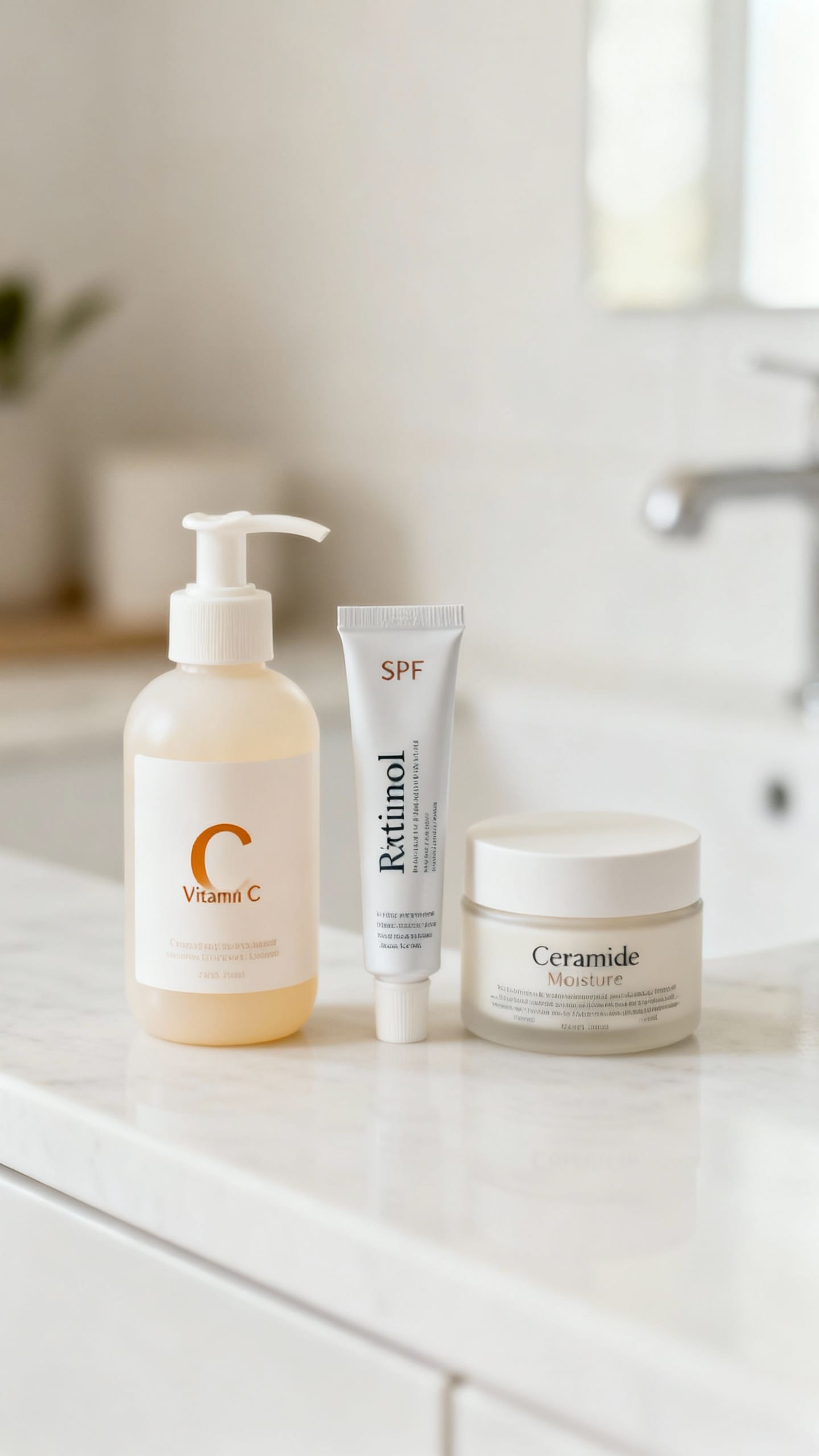
How To Layer Them Safely
Option 1 (Beginner-friendly): AM C, PM Retinol
- AM: Cleanser → Vitamin C serum → Moisturizer → Broad-spectrum SPF 30–50
- PM: Cleanser → Hydrating serum (optional) → Retinol → Moisturizer
Want even gentler? Use the sandwich method: moisturizer → retinol → moisturizer.
Option 2 (Sensitive skin): Alternate nights
- AM daily: Vitamin C → Moisturizer → SPF
- PM: Retinol every other night; use barrier-repair products on off nights
This helps you build tolerance without the surprise peeling.
FYI, patience pays off here.
Option 3 (Advanced users): Same night, split routine
Only if your skin already tolerates both.
- After cleansing, apply vitamin C and let it absorb 10–20 minutes
- Follow with a bland moisturizer, wait another 10 minutes
- Apply retinol
Does everyone need this? No. Will it impress your inner skincare nerd?
Absolutely.
What Not To Do (Unless You Like Redness)
- Don’t start both at high strengths at the same time. You need a test phase.
- Don’t skip sunscreen. Retinol makes you more sun-sensitive, and vitamin C doesn’t replace SPF.
- Don’t pile on extra exfoliants (AHA/BHA) the same nights as retinol if you’re new to actives.
- Don’t chase instant results. Give vitamin C 4–8 weeks and retinol 8–12 weeks for visible changes.
Pairing Tips That Make a Big Difference
Buffer smartly
Use a hydrating serum (glycerin, hyaluronic acid, panthenol) before retinol. It cushions the blow without killing efficacy.
Feed your barrier
Look for moisturizers with ceramides, cholesterol, fatty acids, and squalane. They calm irritation and keep progress steady.
Choose friends, not frenemies
- Great with vitamin C: Niacinamide, ferulic acid, vitamin E, peptides
- Great with retinol: Niacinamide, peptides, centella, oat, ceramides
- Proceed with caution: Strong acids (glycolic, salicylic) and benzoyl peroxide on retinol nights
Who Should Prioritize Which?
- Hyperpigmentation or dullness? Prioritize vitamin C daily, add retinol 2–3 nights a week.
- Acne and texture? Prioritize retinol at night, add a gentle vitamin C derivative in the morning.
- Reactive or rosacea-prone? Try a derivative vitamin C + retinal/low retinol and go slow.
Patch test.
- Pregnant or nursing? Skip retinoids; use vitamin C, niacinamide, azelaic acid instead. Talk to your clinician for personalized advice.
How To Build Your Routine (Simple Cheat Sheets)
Basic glow routine
- AM: Gentle cleanser → 10–15% vitamin C → Lightweight moisturizer → SPF 50
- PM: Cleanser → 0.3% retinol → Ceramide moisturizer
Dry skin routine
- AM: Creamy cleanser → Vitamin C → Rich moisturizer → SPF
- PM: Cleanser → Hydrating serum → Retinol “sandwiched” with moisturizer
Oily/acne-prone routine
- AM: Gentle foaming cleanser → Vitamin C (or niacinamide if C stings) → Oil-free moisturizer → SPF
- PM: Cleanser → Retinol or retinal → Light gel moisturizer
FAQ
Can I mix vitamin C and retinol in the same application?
Most people shouldn’t. You risk irritation, and they shine at different times of day.
If you insist, use a stabilized vitamin C derivative and a low-strength retinol, and buffer with moisturizer. But honestly, morning C and night retinol works better for most skin.
What if vitamin C stings my skin?
Switch to a gentler derivative like sodium ascorbyl phosphate or 3-O-ethyl ascorbic acid. Use 2–3 times a week and build up.
Also check your cleanser—over-cleansing can make any active feel spicy. IMO, keep it simple and hydrate more.
How long until I see results?
Vitamin C: brighter tone in 2–4 weeks, spots fade in 6–12. Retinol: smoother texture in 4–8 weeks, wrinkles and pores improve around 3 months and beyond.
Consistency beats intensity every time.
Can I use niacinamide with vitamin C and retinol?
Yes. The old rumor about them canceling each other out doesn’t apply to modern formulas. Niacinamide plays nice with both and helps with redness, oil control, and barrier support.
It’s the peacekeeper in the squad.
Do I need to stop actives before a big event?
If you’re new to retinol, stop it 3–4 days before to avoid surprise peeling. Keep vitamin C if your skin tolerates it—it adds instant brightness. Patch test anything new well ahead of time.
No one wants a flaky face on photo day.
Which goes first: vitamin C or sunscreen?
Vitamin C first, then moisturizer (optional), then sunscreen. Vitamin C boosts your sunscreen’s antioxidant defense. Reapply SPF every two hours when you’re in the sun—vitamin C can’t save you from UV stubbornness.
Bottom Line
Vitamin C protects; retinol corrects. Use vitamin C in the morning for brightening and defense, and retinol at night for renewal and smoothing.
Start slow, moisturize generously, and wear SPF like it’s your job. Do that, and these two heavy hitters will become your skincare power couple—no drama, just results. FYI, patience + consistency = glow.