


Wall Pilates Workout for Beginners: A Gentle, Effective 20-Minute Routine Anyone Can Start
Wall Pilates is beginner-friendly Pilates-style training that uses a wall as your “assistant.”
The wall helps you stay steady, teaches alignment (so you’re not guessing where your hips/ribs/shoulders should be),
and gives just enough support that you can focus on control instead of balance. You’ll work your core, glutes,
legs, posture muscles, and mobility in one simple session—without jumping, running, or needing equipment.
This routine is intentionally gentle. The goal is clean movement: slow reps, steady breathing, and positions that
feel supportive. You should feel muscular effort (like your thighs working on squats or your glutes firing on bridges),
not sharp pain. If you have a medical condition, recent injury, or you’re unsure what’s safe for you, check with a clinician.
What you need (and how to set up)
All you need is a clear wall space. A yoga mat is optional but helpful for the floor portion. Barefoot or grippy socks
are ideal so your feet don’t slide on the wall. If you’re on carpet, you may feel more stable; if you’re on tile/wood,
grippy socks help a lot.
- Wall space: clear enough to stand, squat, and put your feet up on the wall.
- Optional mat: place one short end against the wall for the bridge portion.
- Optional timer: phone timer makes the 20 minutes effortless.
Key form cues (these make Wall Pilates actually work)
Pilates is less about “doing more” and more about “doing cleaner.” Two cues will instantly improve how this feels:
stack your ribs over your hips and breathe during the effort. When ribs flare forward,
the low back often over-arches and movements shift into the wrong places. When you exhale during the hard part,
your core engages naturally without you needing to over-brace.
- Alignment: ears over shoulders, ribs over hips, weight evenly through your feet.
- Core engagement: think “zip up” from pelvic floor to belly button—firm, not rigid.
- Breath: inhale to prepare, exhale on effort (standing up, lifting hips, holding plank).
The 20-minute routine (full walkthrough)
Below is the exact structure, with what to do, what to feel, and how to modify if something feels too intense.
Move slowly. If you finish a set and feel like you “could have done more,” that’s perfect for week one.
You’ll build consistency and control first, then intensity later.
0:00–3:00 — Warm-up: Wall breathing + posture reset
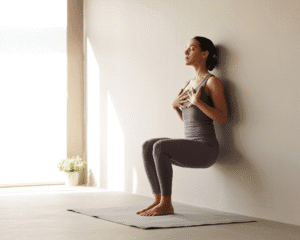
Stand with your back near the wall (you can lightly touch the wall if it helps). Take 4–6 slow breaths.
Inhale through your nose. On the exhale, gently draw your ribs down and feel your pelvis become more neutral
(not tipped forward or tucked aggressively). Then do 6–8 shoulder rolls and 6–8 small chin nods
(tiny nod, like making a “yes” with your head—no big neck bend). This warms your upper back and sets your posture
so the rest of the workout feels smoother.
Warm-up form help
If your low back arches a lot, soften your knees and think “ribs down.” If you feel tense in the shoulders,
breathe into your upper back and let your shoulders drop away from your ears.
3:00–6:00 — Wall Roll-Down (spine mobility + hamstring stretch)
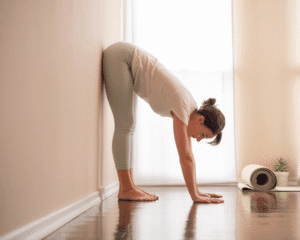
Stand tall with knees slightly bent. Slowly tuck your chin and “peel” your spine down one segment at a time,
like you’re rolling down a window shade. Stop when you feel a gentle hamstring stretch—do not force your hands to the floor.
Inhale at the bottom, then exhale and roll up slowly, stacking your spine back to standing. Do 5 slow reps.
This move teaches control and length. The goal is a smooth roll, not a deep stretch. If you feel it in your low back,
bend your knees more and reduce your range.
6:00–9:00 — Wall Squat (legs + glutes, supported)
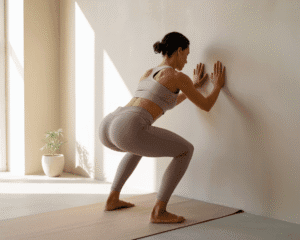
Place your back against the wall and walk your feet 12–18 inches forward, hip-width apart. Slide down to a depth
that feels stable—your knees should track over your toes (not collapsing inward). Hold 10 seconds, then slowly rise
for 10 seconds. Repeat 4–5 times.
Think “press the floor away” as you stand. You should feel thighs and glutes working. If knees feel uncomfortable,
reduce depth and shorten the hold to 5 seconds.
Wall squat modifications
Easier: do mini-squats (small slide down, small slide up). Knee-friendly: keep shins more vertical by stepping feet
slightly farther forward. Harder: add one extra hold at the bottom (5 seconds) each rep.
9:00–12:00 — Calf raises + wall march (ankles, balance, light cardio)
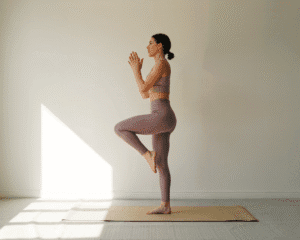
Face the wall and place fingertips on it for balance. Do 15 slow calf raises: rise for 2 counts, lower for 2 counts.
Then do a controlled wall march for 60–75 seconds—lift one knee (as high as comfortable), place it down quietly,
switch sides. Keep your torso tall and ribs stacked.
This block wakes up ankles and hips and gently raises your heart rate. If you feel wobbly, slow down and keep knee lifts smaller.
12:00–16:00 — Glute bridge with feet on the wall (glutes + core)
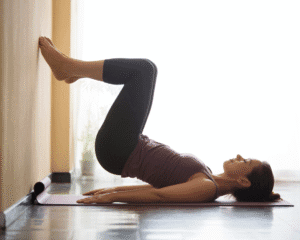
Place a mat with one edge touching the wall. Lie on your back and place feet on the wall, knees bent about 90 degrees.
Exhale, gently engage your core (“zip up”), and lift hips until your body forms a long diagonal from shoulders to knees.
Inhale at the top, then exhale and lower slowly. Do 10–12 reps.
You want to feel this in your glutes and hamstrings, not in your low back. If hamstrings cramp, bring your feet slightly lower
on the wall or closer to your hips, take a breath, and continue with smaller lifts.
Bridge troubleshooting
If you feel low-back pressure, reduce range and focus on ribs down + gentle pelvic tuck before lifting.
If you don’t feel glutes, press through your heels and think “push the wall away with my feet.”
16:00–18:30 — Wall plank (core + shoulders, no floor required)
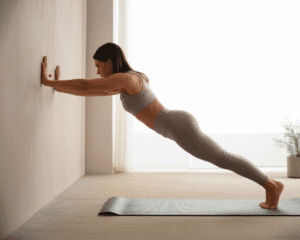
Stand facing the wall and place forearms on it. Step back until your body is a straight line from head to heels.
Lightly squeeze glutes, draw ribs down, and hold for 30–45 seconds. Rest 15 seconds. Repeat once.
This builds core endurance without wrist strain or a difficult floor plank. If it feels too hard, step closer to the wall.
If it feels too easy, step farther back or add 4–6 slow shoulder taps without twisting.
18:30–20:00 — Cool down: chest opener + calf stretch + breathing
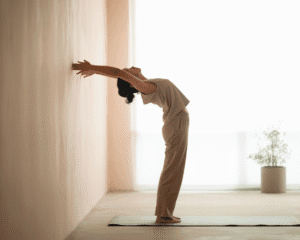
Finish with simple stretches to calm down the nervous system. For a chest opener, place one forearm on the wall,
then gently rotate your body away until you feel a stretch across the chest and front shoulder. Switch sides.
Then stretch calves by placing hands on the wall, stepping one foot back, keeping heel down, and holding 20–30 seconds each side.
Close with two slow breaths, letting your shoulders soften.
How often to do this (beginner schedule that works)
Start with 2–3 times per week. That’s enough to build strength, improve posture, and feel real progress
without getting overly sore. If you want a simple structure: do Wall Pilates on Monday and Friday, then add one easy walk
mid-week. After 2–3 weeks, you can add a third session if it feels good.
Printable routine (no box style)
0:00–3:00 Warm-up (breathing + shoulders + posture)
3:00–6:00 Wall Roll-Down × 5 slow reps
6:00–9:00 Wall Squat: 10s down / 10s up × 4–5
9:00–12:00 Calf Raises × 15 + Wall March 60–75s
12:00–16:00 Feet-on-wall Glute Bridge × 10–12
16:00–18:30 Wall Plank 30–45s × 2 (15s rest)
18:30–20:00 Cool down (chest opener + calf stretch + breathing)